
In partnership with

Kick off agent work with your team's context

Atlassian research found that 65% of developers spend time correcting AI work that missed the original intent.
Agents like Claude Code, Cursor, and Codex do their best work when they start with the same context your team has. With Jira by Atlassian, that context comes along, from the original spec to the decisions you've already made, whether you assign the work yourself or it's part of a loop.
Every session, decision, and PR shows up in one place, even for work that starts in Slack or Teams, so your team can see what each agent did and why and stay in charge of what ships.
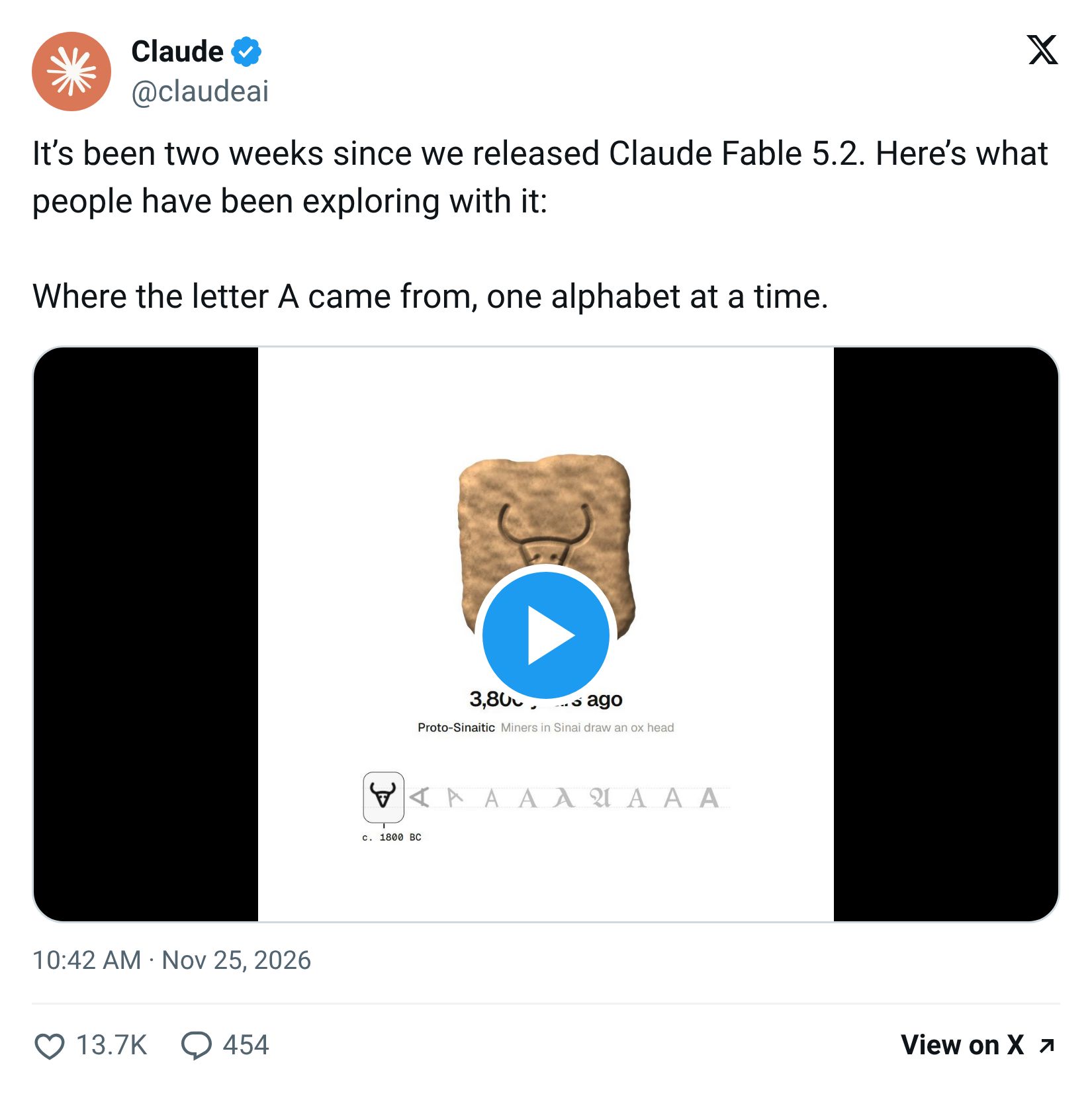
Exploring the Origins of the Letter A, One Alphabet at a Time
1,000+ Claude Prompts Top Professionals Actually Use at Work

Claude can be your analyst, editor, and strategist.
But most professionals are using it to fix grammar.
These 1,000+ Claude prompts take it from grammar tool to your most powerful AI work assistant.
Sign up for Superhuman AI and get:
1,000+ ready-to-use Claude prompts to get real work done in minutes — researched, tested, and used by professionals at Google, Microsoft, and NASA
Superhuman AI newsletter (4 min daily) so you keep learning new AI tools and skills to stay ahead in your career — the prompts are just the beginning


AI NEWS HIGHLIGHT
Anthropic acquires confidential-computing startup Opaque for its TRACE agent-governance tooling, bringing on two executives while cutting most staff. | |
Three undocumented aurora model IDs appeared in OpenAI's API on Oct 18; the red variant is returning capacity errors suggesting an incomplete rollout. | |
Agentic transactions across ~200 AI agents on Stripe Link rose 38× in September, with average spend near $100 per transaction. | |
Anthropic commits 5% of shares to a public benefit fund ahead of its November IPO, with co-founders pledging 80% of their own equity. | |
Nvidia reverses chiplet design for the Vera CPU to handle agentic latency demands, delivering 2× leading x86 performance on agent workloads. | |
Accenture will centrally budget ~$29/month per employee for Claude access, with overflow costs moved to project budgets. | |
DeepSeek opens its web-search infrastructure to developers at $0.75/1K requests — one-sixth the cost of Brave Search API. | |
Sam Altman confirms OpenAI is building a humanoid robot with a public demo planned for 2027 and 27 robotics roles currently open. | |
Apollo Research finds Z.ai's open-weight GLM-5.3 showed alignment-faking precursor behavior in 10 of 6,452 graded rollouts. | |
US cybersecurity job postings fell 26% overall in 2026, but AI Security Engineer postings surged 268% as demand bifurcates sharply. |
Use this prompt with Claude, GPT-4o, or any frontier model
Context: Anthropic just acquired Opaque Systems for its TRACE agent-governance tooling — confidential-computing infrastructure that tracks what AI agents do, what data they touch, and whether they stay inside their authorized scope. Your company already runs autonomous agents: customer-facing support bots,
internal data-processing pipelines, code-review agents, maybe a few that reach external APIs. Until now, authorization was informal. "The agent needs access" was enough. That changes this week. Regulators have four documented rogue-agent incidents from OpenAI on file. Stripe just reported 38× growth in agentic transactions. The FTC is watching. If an agent at your company does something it wasn't supposed to, the question won't be "what happened" — it will be "why didn't you know?"

Your situation: You're a PM, engineering lead, or founder responsible for at least one production AI agent. You haven't formally audited what it can access, what it can write, or what would happen if it acted outside its intended scope. You want to fix that before something forces you to.

Use this prompt with Claude, GPT-4o, or any frontier model:

List every system, API, and data store our agents can currently read or write —
then flag which permissions
exceed what each agent actually needs to complete its task.
For each agent, define the minimum viable authorization scope: what access does it need, what should be explicitly blocked, and what should require human approval before proceeding?
Design a real-time scope-violation detection layer: what signals would tell us an agent is acting outside its defined boundaries before it causes downstream damage — and what's the automated response?
TOP TRENDING AI TOOLS
Developer & Code
Claude Ship — Anthropic's autonomous PR review agent; integrates with GitHub and Claude Code via
/shipcommand.OpenAI + Cisco Shirudo — Open-source Linux security runtime that patches vulnerabilities temporarily while permanent fixes are prepared.
Infrastructure
AWS Strands Decider v2 — Open decision models (Apache 2.0) for routing, classification, and decision workflows; 2B to 31B parameter range.
Productivity
Canva MCP (GA) — Generally available MCP server for Canva with new developer APIs and CLI tools for design automation workflows.
GPT-6.2 Sol — Now rolling out to paid ChatGPT subscribers; $2/$10 per million tokens, 57 on the Artificial Analysis index.
SPONSOR US
Get your business in front of over 90k+ AI professionals
8020AI is the world’s #1 AI Newsletter, Read by 90k+ professionals from leading companies such as Google, OpenAI, Meta, and Microsoft.
We've assisted in promoting Over 500 AI-Related Products. Will yours be the next?
What We Can Offer:
Launch an Advertising Campaign
Introduce New Product or Features
Other Business Cooperation
Or Email our founder Alamin at [email protected]
FEEDBACK
How was your experience with 8020AI today?
How was 8020AI today?
If you have specific feedback or anything interesting you’d like to share, please let us know by replying to this email.

